Showing posts with label Swans Geese and Ducks. Show all posts

Increasing the odds of survival

The road where Tammy's mother lives has a small creek running more or less parallel to it. This creates a series of back yards that are bordered by this creek. The creek was very nice and relaxing to listen to. And the Mallards liked it too. In fact, the Mallards loved the creek, and all of the nice lawns right next to the creek. I only counted about six adults while they wandered from yard to yard, across the road, back into the creek or wherever, so it was not a gigantic population of ducks. They were, however, attempting to change that.

Apparently it is not uncommon in the neighborhood to find a nest with eggs, but most get destroyed because they are in people's yards. At least one, however, was successful. The picture below was a photo I took facing upstream, looking between the railing and floorboards of a little bridge, at a single female Mallard and thirteen chicks! That is a whole lot of Mallard potential there, and another shining example of the Mallard master plan for controlling the world.

Busy Mother

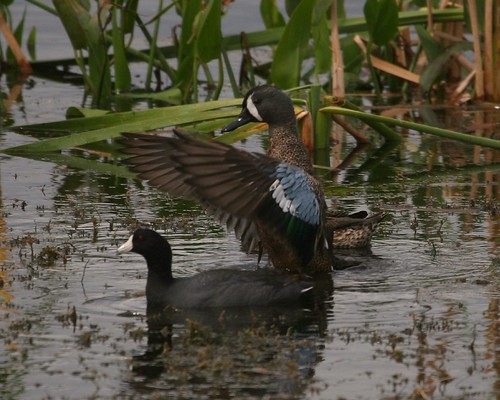
Blue-winged Teal

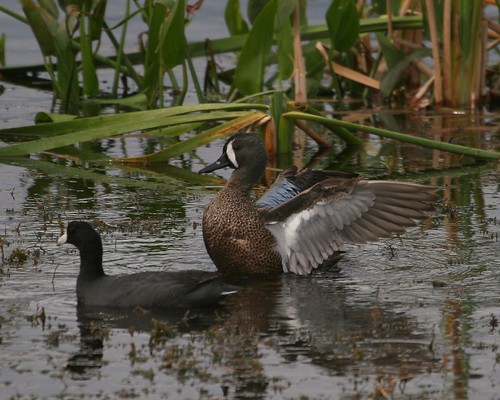
More pictures from Orlando Wetlands Park. Here are a couple shots of a Blue-winged Teal stretching his wings. The pictures make it fairly obvious how the species got its name. The black bird in the front is an American Coot. The bird at the back that is obscured is a female Blue-winged Teal.

Blue-winged Teal
Blue-winged Teal

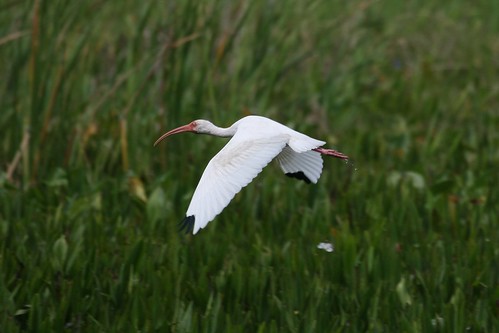
White Ibis

I figure that I will deal with my pictures and blog posts from the Florida trip by attrition. Each night that I am at home I clean up a few pictures and, maybe, make a blog post with some of the better pictures.

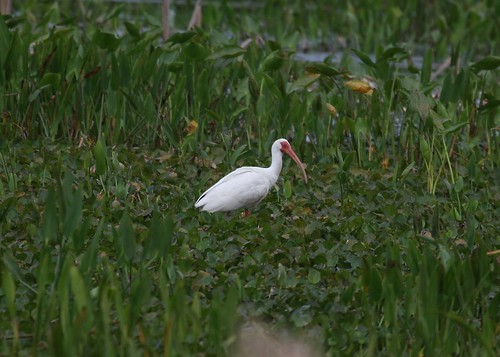
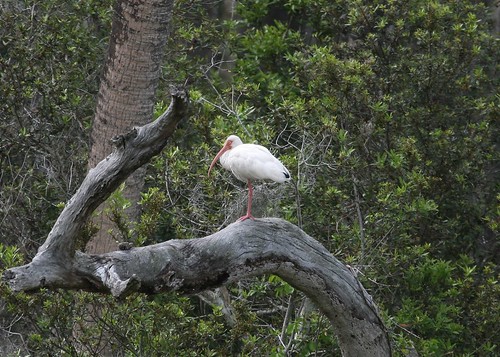
Tonight I have more from Orlando Wetlands Park. This time the subject of choice is White Ibis. Here are three pictures: one wading, one in a tree and one in flight.

White Ibis
White Ibis
White Ibis

I think I said it was cold

A few posts back, when I described the trip to Chincoteague, I think I said it was cold. If I didn't, then let me correct that misunderstanding. It was cold. And when the wind blew, it was a type of cold that requires the use of profanity to describe. Here are a few miscellaneous photos that include ice, just as a guide of the coldness of it all.

The first picture is of a piece of wood or stump that was sticking up out of the water. The wind was blowing hard enough to send a sheet of ice from one end of the pond to the other. When the ice encountered the piece of wood, the ice was thin enough for the wood to carve right through it, leaving that trail of broken ice to the right of the stump.
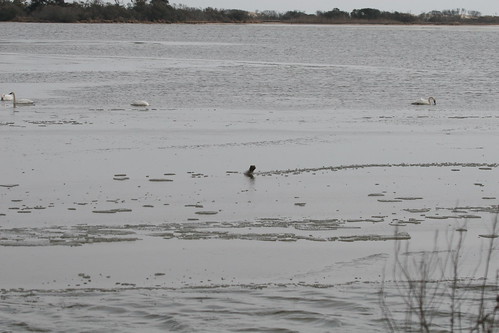
Stump Carving Ice

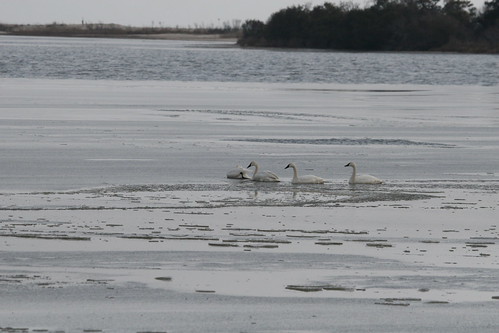
This picture shows a group of Tundra Swan trying to get to the other side of a sheet of ice. One of the group just took flight and flew over. These, however, decided it would be easier to climb up and walk over the ice.
Tundra Swan

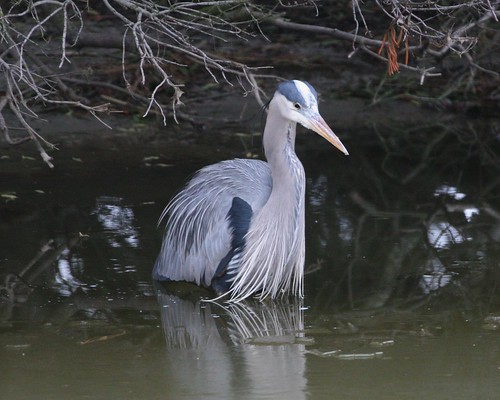
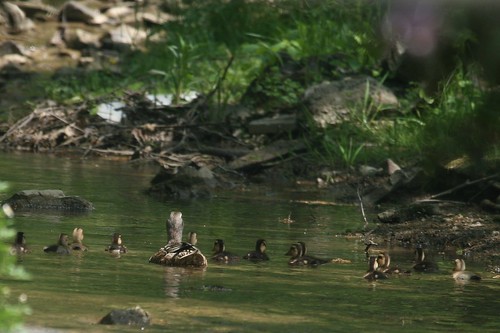
Finally, here is a shot of what I presume to be a very cold Great Blue Heron. To be more precise: I do not presume that this is a Great Blue Heron, but I do presume he is cold. He is standing up to his feathers in water, right next to a section that is frozen on top. It is almost like a Great Blue Heron Popsicle.
Great Blue Heron

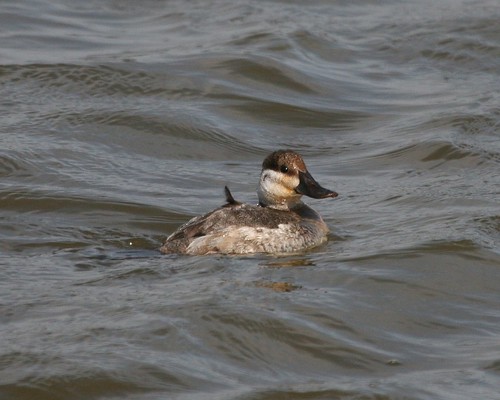
Ruddy Duck

Here is another photo from the driver's side of my truck out the passenger side window. This one is of a female Ruddy Duck. I think the shape of these were the model for the little rubber duck bathtub toys. They look like little toy ducks.

Ruddy Duck

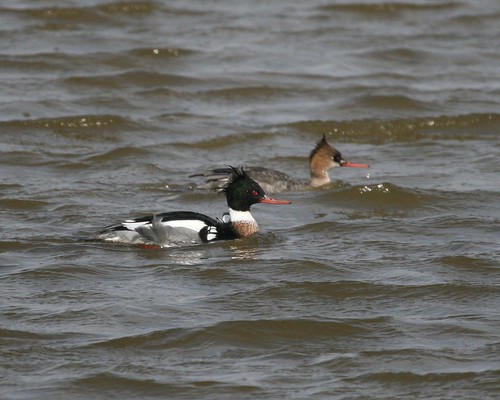
Red-breasted Merganser

During Winter in Virginia it is not uncommon to see Red-breasted Merganser in larger bodies of water. These birds dive under water for their food (unlike dabbling ducks, who tip their head under water, but do not dive). They are also extremely shy, and will dive under water and/or fly away if they see you walking nearby. At Chincoteague NWR, you can drive past lots of good bird habitat. So not only is staying in your vehicle good for keeping warm in the winter, but it also acts as a handy bird blind. I took this photo from my truck. We were parked on the side of the road, and I took the photo from the driver's side through the rolled down passenger side window. Tammy is patiently reclined out of the way in the passenger seat. This is a male/female pair of Red-breasted Merganser. The male is closer, and the female is in the back.

Red-breasted Merganser

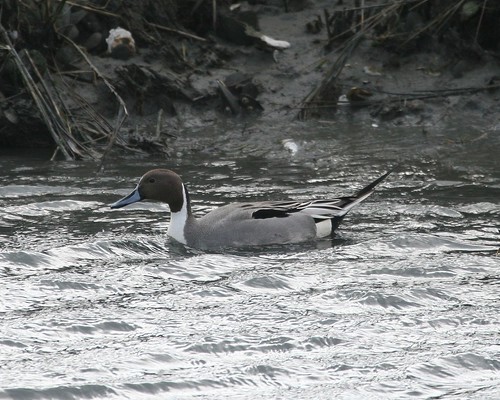
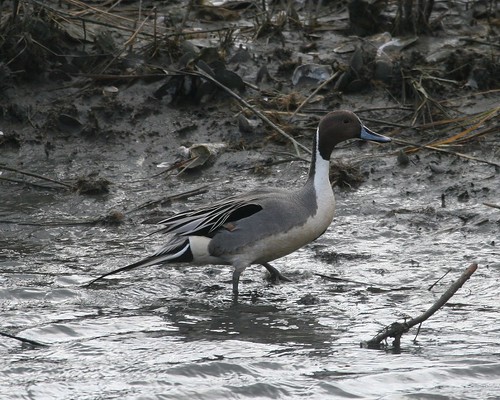
Northern Pintail

Another fairly common dabbling duck at Chincoteague was Northern Pintail. Once again the male has fairly interesting colors, and it is pretty easy to see how the bird got its name.

Northern Pintail
Northern Pintail

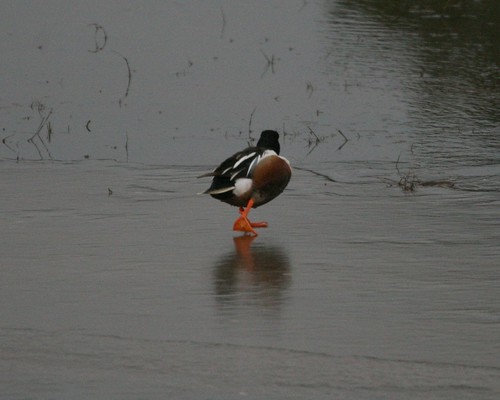
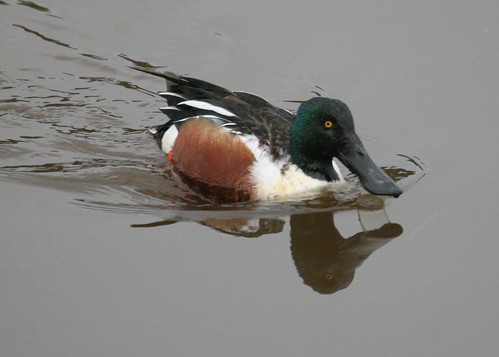
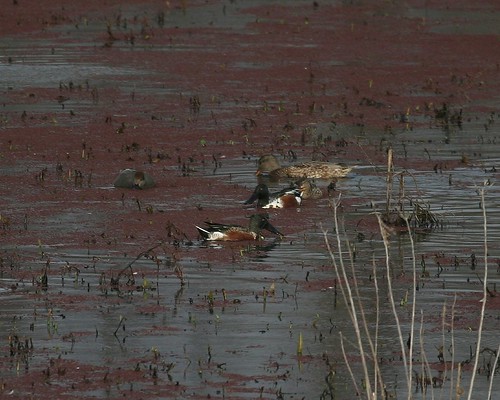
Northern Shoveler

There was no shortage of dabbling ducks at Chincoteague NWR. One species that was particularly abundant was Northern Shoveler. They were to be found in any shallow water, heads under the icy water eating whatever manner of vegetation is to be found there. The males have interesting colors, and their bills do justice to their name.

Northern Shoveler
Northern Shoveler

DGCA in Winter - Ducks

I had today off from work (Martin Luther King Day), so I took advantage of the day by making a trip to Dutch Gap Conservation Area (DGCA) to see what birds are wintering there. It was cloudy and looked like it could rain, but it stayed dry and relatively warm for January. It was also fairly windy.

The usual wintering birds include a good variety of ducks. I had my camera with me so I managed to get a few fuzzy pictures.

DGCA Ducks

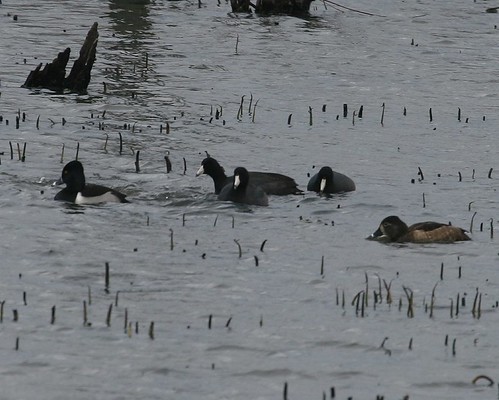
The first picture has both Ring-necked Ducks (a male on the left and a female on the right) and American Coots (the three in the center). The water appears to be churning because they are continuously diving for food as I am taking pictures of them. The Coots are actually more closely related to Rails, but they act like Ducks.

DGCA Ducks

The second picture is of Northern Shovelers (with the big flat bills) and Gadwall (the gray bodied duck with a brownish cap on its head in the back left portion of the picture is a male, the brownish bird in the center back is the female). These ducks are "dabblers", meaning that they generally tip their head under water to feed, but usually do not dive under water to feed.

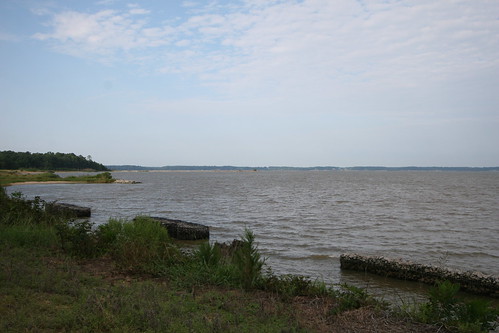
View of the James River

James River

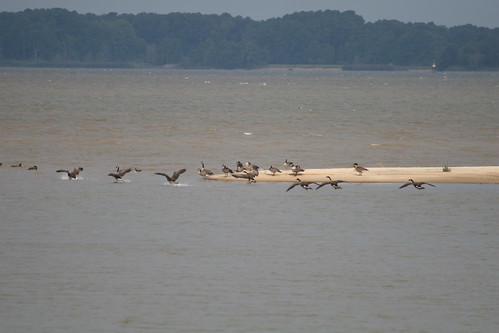
Canada Geese


As I mentioned before, Hog Island sits in a bend of the James River near Williamsburg, Virginia. It is just downstream, and on the opposite bank, from the Jamestown Settlement. These two pictures look out over the James River in the upstream direction. I wish I could say that you could see Jamestown from these photos, but that would be pretty much a lie. Instead of focusing on that, look at the pretty geese!