When we departed Seward, and said goodbye to Exit Glacier, our destination was Homer. Rather than explain the driving route, I will just include a handy Google map. Homer is near the tip of the Kenai Peninsula.
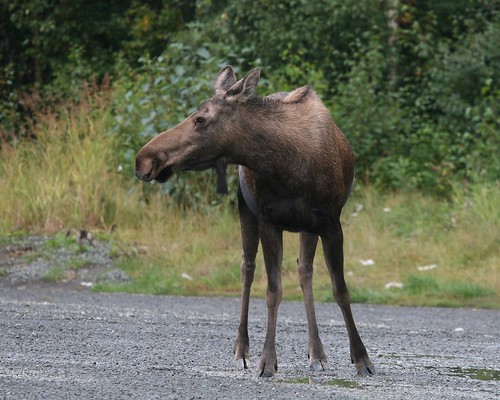
Along that drive we had a Moose sighting. We came over a hill and there was a large gravel area on the right side of the road. In that gravel area, drinking from a puddle of water, was a Moose. We quickly pulled over, joining a couple other vehicles. We then gawked, pointed and took photos from the safety of our car. The Moose drank, looked back, and seemed a bit nervous about all the attention. After just a minute or two, we left the Moose with its puddle and continued on to Homer.
Homer has a neat geologic feature: the Spit. The Homer Spit is a thin strip of land that juts 4.5 miles out into the water of Kachemak Bay. I didn't believe it at first, but it is naturally occurring, with a couple theories on how it came to be: either built by the interaction of water in Kachemak Bay and Cook Inlet, or a moraine left by some long retreated glacier. There are all sorts of restaurants, shops, fishing and tourism businesses along the spit. There is even a campground, a harbor and, out on the very tip, a hotel (which is where we stayed...the building with the purple roof).
Showing posts with label Things With Hooves. Show all posts
Driving To Seward
We were now one day closer to our boat trip. The boat trip, however, departed from Seward, so this day was all about driving from point A (Anchorage) to point C (Seward) with a short side trip to point B (Portage Lake).
View Larger Map
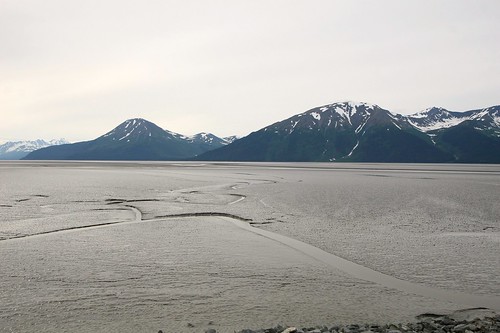
This drive took us past Turnagain Arm (again). Since it was another mostly cloudy day, and the tide was out, it looked the same this day as it had on our previous visit.
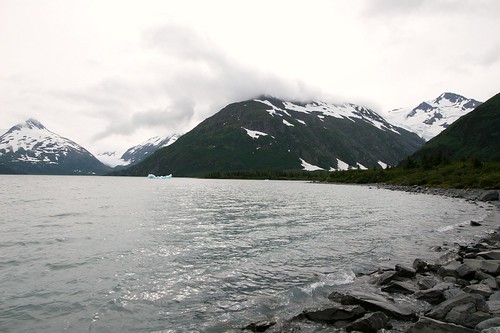
My previous post of the horse shaped iceberg (or is it dragon shaped?) was from the short side trip to Portage Lake. Here is a wide-angle view of Portage Lake, taken from the Begich, Boggs Visitor Center. The distant glacier in this photo (middle left) is actually Burns Glacier, not Portage Glacier. About a hundred years ago, Burns Glacier flowed into Portage Glacier, and Portage Glacier terminated close to where this picture was taken. Since then, Portage Glacier has receded considerably (nearly 5km), exposing Portage Lake along the way. It has, however, been fairly stable since 1999. While the retreat of Portage Glacier was helped by a warming climate, the main driver was the transition from a land-based terminus to a water-based terminus. Said another way, glacier ice calves more frequently in water than on land. You can read a more thorough history (and see historical photos) here.
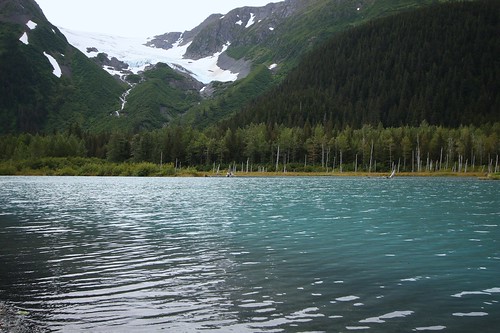
We also stopped to experience the quiet beauty of a lake with views of Explorer Glacier. We could have sat here for hours, but lack of food and the desire to arrive in Seward urged us onward.
After our little side trip to Portage Lake, we got back onto the main road heading south towards Seward. Soon after that we discovered the Alaska Wildlife Conservation Center (AWCC). They are a non-profit that takes in injured and orphaned animals. Those that cannot be released back into the wild are given a home on the AWCC property. You can drive or walk through and see Moose, Elk, Black Bear, Grizzly Bear, and a few others.
I am glad that there is a group like the AWCC to care for these animals. I suspect that without the AWCC, these animals would not be alive. But seeing wild animals kept behind fences has always been a bittersweet experience for me. As much space as the AWCC provides these animals, they are still stuck behind a fence. Ah...if only the world was the perfect place I wished it would be ;-)
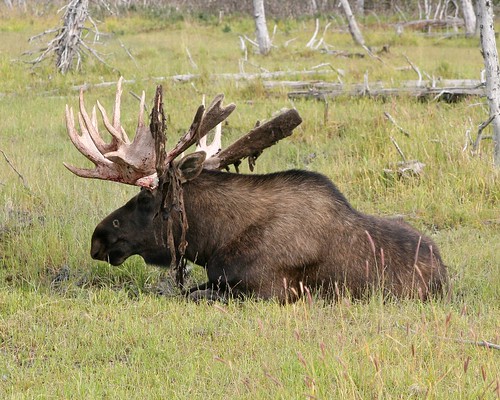
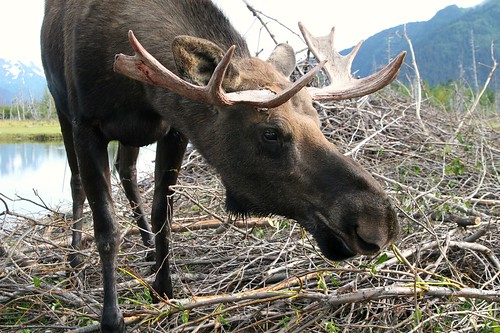
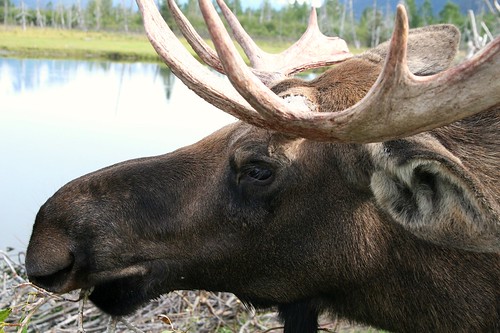
The resident Moose seemed very used to humans. They would saunter up to the fence even when people were nearby. We got a nice face-to-face encounter with a Moose.
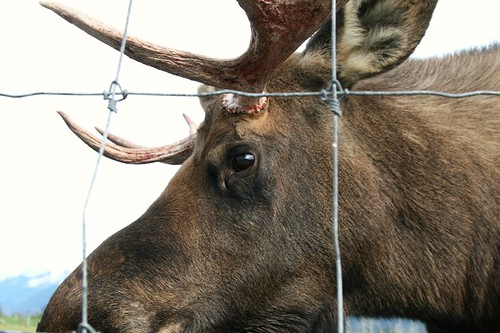
Other than good judgment (and a dose of fear), there was nothing preventing me from reaching through the fence to touch this really large animal. I saw some others doing that very thing later in our visit, but that fence did not seem to really provide much of a barrier. Moose are BIG, and they have pointy antlers.
View Larger Map
This drive took us past Turnagain Arm (again). Since it was another mostly cloudy day, and the tide was out, it looked the same this day as it had on our previous visit.
My previous post of the horse shaped iceberg (or is it dragon shaped?) was from the short side trip to Portage Lake. Here is a wide-angle view of Portage Lake, taken from the Begich, Boggs Visitor Center. The distant glacier in this photo (middle left) is actually Burns Glacier, not Portage Glacier. About a hundred years ago, Burns Glacier flowed into Portage Glacier, and Portage Glacier terminated close to where this picture was taken. Since then, Portage Glacier has receded considerably (nearly 5km), exposing Portage Lake along the way. It has, however, been fairly stable since 1999. While the retreat of Portage Glacier was helped by a warming climate, the main driver was the transition from a land-based terminus to a water-based terminus. Said another way, glacier ice calves more frequently in water than on land. You can read a more thorough history (and see historical photos) here.
We also stopped to experience the quiet beauty of a lake with views of Explorer Glacier. We could have sat here for hours, but lack of food and the desire to arrive in Seward urged us onward.
After our little side trip to Portage Lake, we got back onto the main road heading south towards Seward. Soon after that we discovered the Alaska Wildlife Conservation Center (AWCC). They are a non-profit that takes in injured and orphaned animals. Those that cannot be released back into the wild are given a home on the AWCC property. You can drive or walk through and see Moose, Elk, Black Bear, Grizzly Bear, and a few others.
I am glad that there is a group like the AWCC to care for these animals. I suspect that without the AWCC, these animals would not be alive. But seeing wild animals kept behind fences has always been a bittersweet experience for me. As much space as the AWCC provides these animals, they are still stuck behind a fence. Ah...if only the world was the perfect place I wished it would be ;-)
The resident Moose seemed very used to humans. They would saunter up to the fence even when people were nearby. We got a nice face-to-face encounter with a Moose.
Other than good judgment (and a dose of fear), there was nothing preventing me from reaching through the fence to touch this really large animal. I saw some others doing that very thing later in our visit, but that fence did not seem to really provide much of a barrier. Moose are BIG, and they have pointy antlers.
Silver Lake
One of my field trips during the ABA convention included a visit to a place called Silver Lake, located next to the Brighton Ski Resort. It was nestled in the Wasatch Mountains, just east of Salt Lake City. This place was quiet and tranquil and beautiful, but mostly gave me the impression of a ski resort that was patiently waiting for winter to return. Ski resorts in summer are somewhat like beaches in the winter: ghosts of their full vibrant selves.
There were plenty of good bird watching moments on this trip. We had several looks at flycatchers, warblers and sparrows, most of which were species that I was not going to see back home. And when a Northern Goshawk flew right over our group, everyone was pretty darn excited. I was too focused on seeing that bird through my bins to have even considered taking photo.
I did, however, get a few photos from Silver Lake. For me, this was a challenging day for photography. It started with a Mule Deer that we spooked upon first arriving at the lake. I snapped several photos, but all of them were just not quite in focus. Maybe it was still too early, and my brain was just not quite in focus? Then, as we wound around the lake, the light always seemed to be harsh and coming from the wrong direction. Or, the light was shy, and my subject sat in shadows. It seems that me and my camera were not on good terms this day.
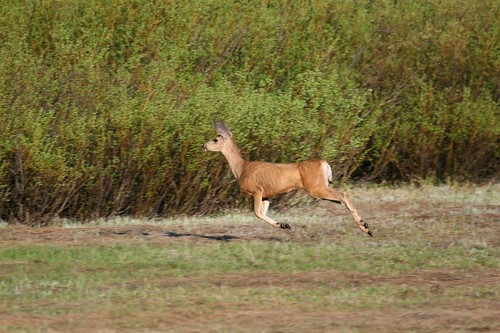
Here is that Mule Deer we spooked. Their odd way of running, with all four feet coming down at the same time, is interesting to watch. Apparently the term for this style of running is "stotting". My photo caught the deer in "mid-stot" :-)
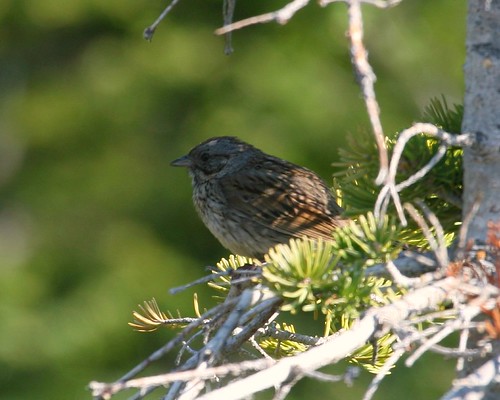
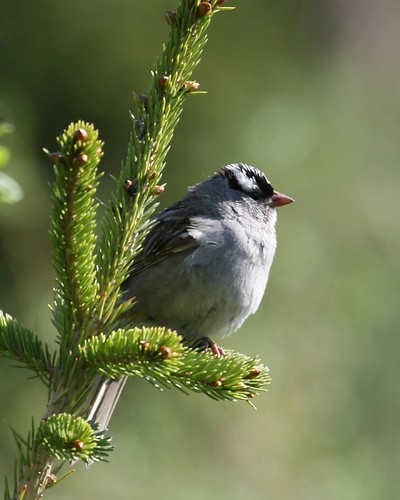
Finally, here are two photos of sparrows. The group had been seeing and hearing Lincoln's and White-crowned Sparrows all morning. Towards the end of our walk around the lake, I had opportunities to get photos of each. The Lincoln's Sparrow sat cautiously on the shadowy side of a tree, and the White-crowned Sparrow sat boldly in the full sun.
Life on a Volcano
After Tammy and I watched Old Faithful erupt, we hiked a five mile trail that explored Upper and Midway Geyser Basin. This trail was a mixture of gravel path and boardwalk that takes you past the myriad geothermal features in the area. This was an other-worldly place that smelled of hydrogen sulfide, was clouded by waves of steam, and was a confusing mix of warm wet air and cold dry air. In the middle of all of that, however, there were animals living out their lives, apparently ignorant of, or adjusted to, the volcanic workings of the area.
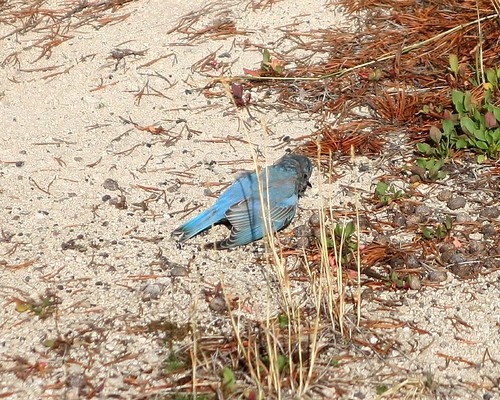
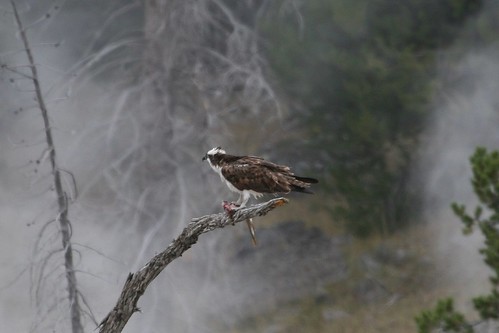
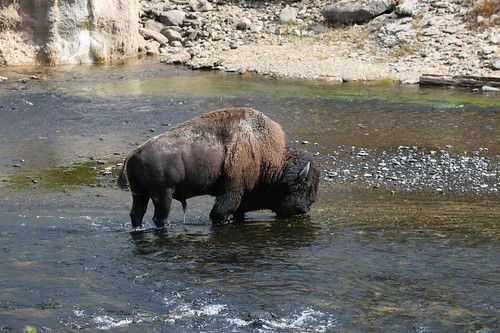
The first picture is of a Mountain Bluebird. These were fairly common, and their behaviors reminded me of the Eastern Bluebird that I am more familiar with. The second picture is of an Osprey eating a fish (I am assuming it is trout) while steam from some geothermal feature wafts by in the background. And the third picture is another American Bison, this one crossing Firehole River. The "rock wall" in the upper left corner of this picture is the outer wall of Riverside Geyser.
Moose
Before I switch over to bird photos, I figured I would post one more mammal of the four-legged variety. A few days back I shared a photo of a cow and calf moose running away from our car in Bear Lake NWR, but this is a full grown male moose. He's big, and gots large antlers!
We spotted this creature in Grand Teton National Park. Much the same as Yellowstone, the large number of pulled over cars, and the presence of park rangers to keep the traffic moving and people a safe distance away from the animal, was our indicator that we might want to stop and check things out. There was a nice crowd of folks standing behind the park ranger, many with camera in hand, taking photos of this giant.
Tammy and I gingerly walked into the group, taking care not to get in anyone's photographic line of sight. Then we proceeded to take our own pictures. Mine were of the moose, but Tammy's were of the back of the head of a first class jack-ass. Someone else did not have the same courtesy as Tammy and I, and they planted themselves right in front of Tammy as she took her first picture. And then the moose laid down in the grass, becoming nearly invisible (believe it or not...that huge thing really did become just a discussion once he laid down...you could not see him). Tammy was just a "tad annoyed" until she heard some other woman complain about the same guy. Then she became quite steamed. That guy, of course, was like the moose, and now nowhere to be seen.
So, despite the frustration it may cause Tammy, here is my shot of that big male moose. And if that rude photo-op dude happens to read this, you were lucky to not get a slap in the face. And next time, watch where you are walking!
Pronghorn
Another fairly common mammal of Yellowstone National Park is the Pronghorn. This animal is often called a "Pronghorn Antelope" (including by me, up until I wrote this blog post), but according to Wikipedia, it is not really an antelope at all.
One afternoon, Tammy and I decided to hike a trail that started in the Yellowstone Picnic Area (in the northeast corner of the park), and paralleled the Yellowstone River Canyon for a couple of miles. It was a beautiful hike, even though I was not exceptionally comfortable hiking along a nearly 500 foot drop. I personally decided that a new trail, about 5 feet further away from the canyon, but otherwise exactly parallel to the existing trail, would be better suited for my needs. When we got to the point where trail headed away from the canyon, however, we had beautiful views of a shallower section of the canyon, known as Bannock Ford, part of the Bannock Trail (photo #1).
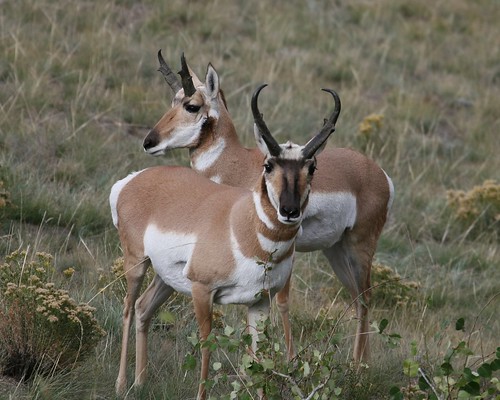
After we turned away from the canyon and began the second half of the loop, we came across three Pronghorn that were chilling out in the meadow. We spooked them, but they did not just run away (photos #2 and #3). They acted nervous, and the male of the bunch kept making this sneezing noise, something that Tammy and I both interpreted as "don't come any closer". We obliged, and simply took photos until the Pronghorn moved away from the trail.


You Should Call This Elk "Sir"
Seeing elk in Yellowstone National Park is nearly as easy as seeing bison. The elk do not get in the way nearly as much as the bison do, but they are still found near the roads often enough, causing people to slow down or stop in order to get a better look or a photo. There was one place in particular, however, where the elk caused no shortage of angst for the park staff: Mammoth Hot Springs.
I do not know if it is the time of year, or if it is all the manicured green grass, but the little oasis of Mammoth, located on the north side of the park, has its own elk herd. To be more precise, it has one dominant stag, 15 to 20 cows that are part of his "harem", and one or two or three other stags who are looking to get in on some "cow action". The dominant stag, by the way, is the jealous type, and likes to share with no one.
Since the elk are so accessible to us humans in Mammoth, the park rangers have a constant struggle on their hands. The humans must stay back 25 yards or so from the herd, no matter where the herd happens to wander. So the park rangers are often times acting as this giant circle of traffic cops, telling people to back up, move along, watch out or whatever is necessary to keep us humans safe from that herd. Or, to be more precise, safe from that jealous dominant stag. Apparently, even a human who gets between him and one of his harem might spark his ire. Some unlucky (or stupid?) people end up on the wrong end of those antlers.
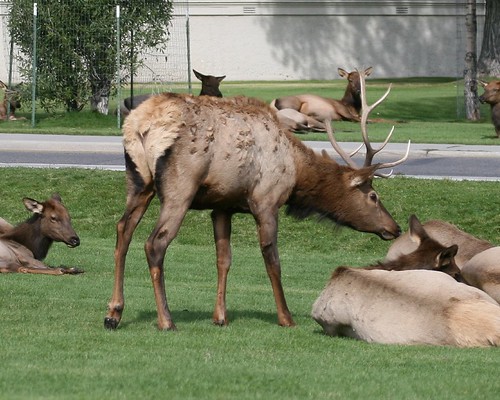
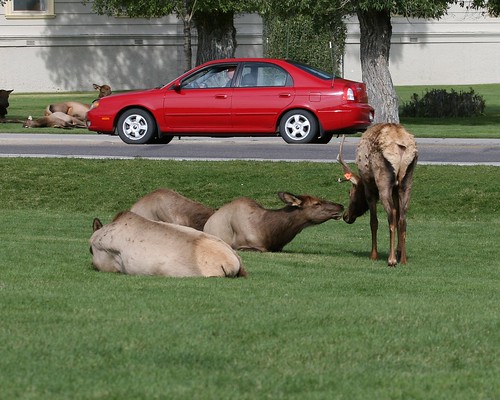
Of course, Tammy and I were part of the throng of people being herded by the park rangers as they worked to keep the human herd and the elk herd from intermingling. We were in Mammoth to grab some lunch, so we took the opportunity to take pictures of the elk. And we were lucky. Another male elk came sneaking in and was trying to "make friends" with some of the cows. When the dominant stag noticed the interloper, the chase was on. Out with the interloper! The fourth picture below gives a pretty good indication of just how large that dominant stag actually is. The interloper had no choice but to run. After the interloper had been dispatched, the dominant male came back to his harem, herded them into an even closer bunch than before, made that bugle noise that male elk make during the fall, and rubbed his antlers all over the ground. I guess in the world of elk, all that stuff means "Not in my house!".


I do not know if it is the time of year, or if it is all the manicured green grass, but the little oasis of Mammoth, located on the north side of the park, has its own elk herd. To be more precise, it has one dominant stag, 15 to 20 cows that are part of his "harem", and one or two or three other stags who are looking to get in on some "cow action". The dominant stag, by the way, is the jealous type, and likes to share with no one.
Since the elk are so accessible to us humans in Mammoth, the park rangers have a constant struggle on their hands. The humans must stay back 25 yards or so from the herd, no matter where the herd happens to wander. So the park rangers are often times acting as this giant circle of traffic cops, telling people to back up, move along, watch out or whatever is necessary to keep us humans safe from that herd. Or, to be more precise, safe from that jealous dominant stag. Apparently, even a human who gets between him and one of his harem might spark his ire. Some unlucky (or stupid?) people end up on the wrong end of those antlers.
Of course, Tammy and I were part of the throng of people being herded by the park rangers as they worked to keep the human herd and the elk herd from intermingling. We were in Mammoth to grab some lunch, so we took the opportunity to take pictures of the elk. And we were lucky. Another male elk came sneaking in and was trying to "make friends" with some of the cows. When the dominant stag noticed the interloper, the chase was on. Out with the interloper! The fourth picture below gives a pretty good indication of just how large that dominant stag actually is. The interloper had no choice but to run. After the interloper had been dispatched, the dominant male came back to his harem, herded them into an even closer bunch than before, made that bugle noise that male elk make during the fall, and rubbed his antlers all over the ground. I guess in the world of elk, all that stuff means "Not in my house!".


These Bison Sure Look Like Buffalo
I knew that we would see bison on our trip out west. There is a herd located on Antelope Island near Salt Lake City, and I was fairly sure we would see one or two in Yellowstone. In reality, you are pretty likely to literally drive into a bison in Yellowstone if you are not paying attention.
When we first entered the park, we thought the bison were so cool, and would slow down or stop to gawk and take photos, thinking we were seeing the best bison photo opportunities ever. I am sure we annoyed some folks who were in cars behind us. Towards the end of our trip, however, we realized that bison were very common, and we began to scoff at the other tourists who were stopping for every little bit of bison that they noticed while driving through the park.
One of the deceiving things about bison is how dangerous they are. They seem very docile, slow and pretty dopey. Statistics from Yellowstone National Park, however, record a different tale: bison charge a human an average of five times a year, compared to a bear attacking a human an average of only one time a year. That difference is probably driven by how many more bison you see (vs. the number of bears you see), and the misperception that bison are not really dangerous animals (which causes people to get way too close to bison).
Tammy and I were also wondering if there was a difference between a bison and a buffalo. The technical biological answer is "yes", but when it comes to American history, the answer is "no". That is because when early American settlers found these large bovines, they called them buffalo in error, because they were similar to Water Buffalo from the far east. In reality, the American Buffalo is really an American Bison.
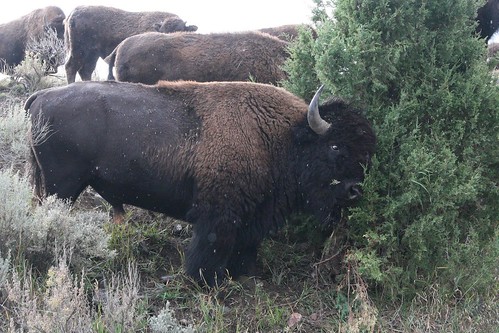
Here are a selection of my favorite bison photos from the Yellowstone trip. All of these were taken from inside our car. If I were on foot and this close to these bison, I would have deserved any abuse that the bison elected to dish out.


Moose Running Scared
As I mentioned in my Sunday Drive post, Tammy and I stopped at Bear Lake NWR to do some bird watching. We got there around lunch time and had the place to ourselves. There were plenty of birds to be seen, but eventually the time of day started to press on us since we had about three more hours of driving to go. So we began to drive out of the reserve.
The roads in the preserve are all gravel, with plenty of washboards, so we really could not go that fast. As we drove towards the exit, however, Tammy and I were both startled by something rather large and furry running out of the weeds ahead and to the right of the car. Our drive out of the park had spooked a momma moose and her calf, and they were even more startled by our presence than we were of theirs. I managed to get the car stopped in time to snap a few photos through the passenger side window, which Tammy had graciously rolled down.
Deer
Whenever you enter Shenandoah National Park, whether driving, biking or hiking, you are likely to see at least one deer. In my experience, this likelihood increases the closer you are to one of the campgrounds in Shenandoah, like Big Meadows [pdf]. My theory is that there is a lot more food available for the deer where groups of humans spend lots of time. In other words, our trash and handouts are like a big convenience store for the deer (and other animals). Keep in mind that I have not done anything scientific to test my theory (like actually counting deer at various distances from campgrounds). Nor have I actively considered other variables that might be at work here (variables other than the misdirected kindness and general negligence of humans). So, at this point, my theory is nothing more than blog fodder.
And a segue for cute deer pictures.
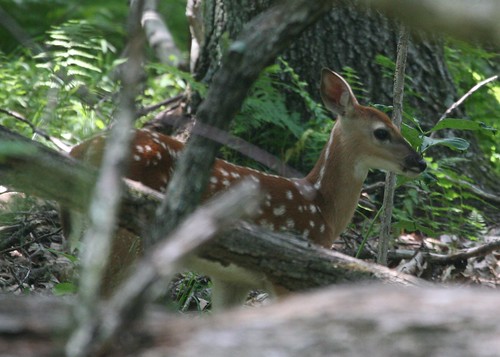
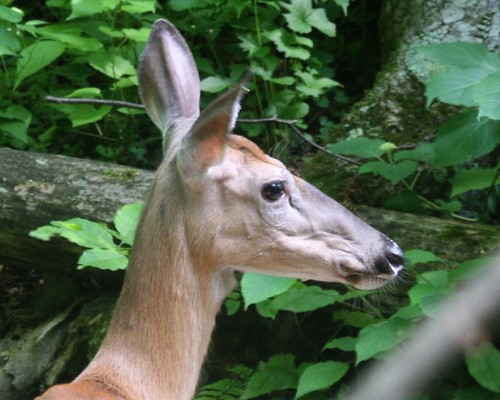
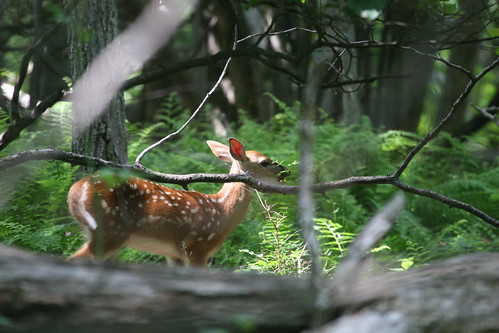
These are White-tailed Deer. All of these pictures were taken while Tammy and I were on our recent Dark Hollow Rose River Loop hike, which is coincidentally near the Big Meadows Campground.


And a segue for cute deer pictures.
These are White-tailed Deer. All of these pictures were taken while Tammy and I were on our recent Dark Hollow Rose River Loop hike, which is coincidentally near the Big Meadows Campground.


Deer in ferns
Two weekends back Tammy and I visited Ragged Mountain Natural Area, in Charlottesville, for a small day hike. The trails are essentially around the Charlottesville Reservoir. One thing that was unique about this park was that no pets are allowed, not even leashed dogs. The reason given was that it increased the wildlife viewing enjoyment for all visitors to the park. I can agree with that logic.
[edit: the trails are not really "in and around" the reservoir...they are really just "around" the reservoir :-)]
On the one hand, I can see how a dog owner would find that rule annoying or unfair. On the other hand, I have been at plenty of parks that allowed leashed dogs but saw dog owners that ignored the part about a leash, and let their dog run free. That can be annoying or unfair to people who are in the park and not particularly interested in interacting with the dog, or would rather the dog did not disturb whatever wildlife there was to view.
Like this deer, chilling out in the ferns.
Elk Herd

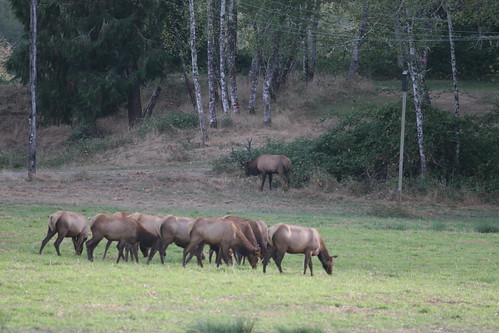
After we started heading inland, we came across this herd of Elk that were grazing on Bureau of Land Management property near Reedsport. I realized that I had not taken any pictures this trip of something with hooves, so I had to stop and snap a photo.
Subscribe to:
Posts (Atom)